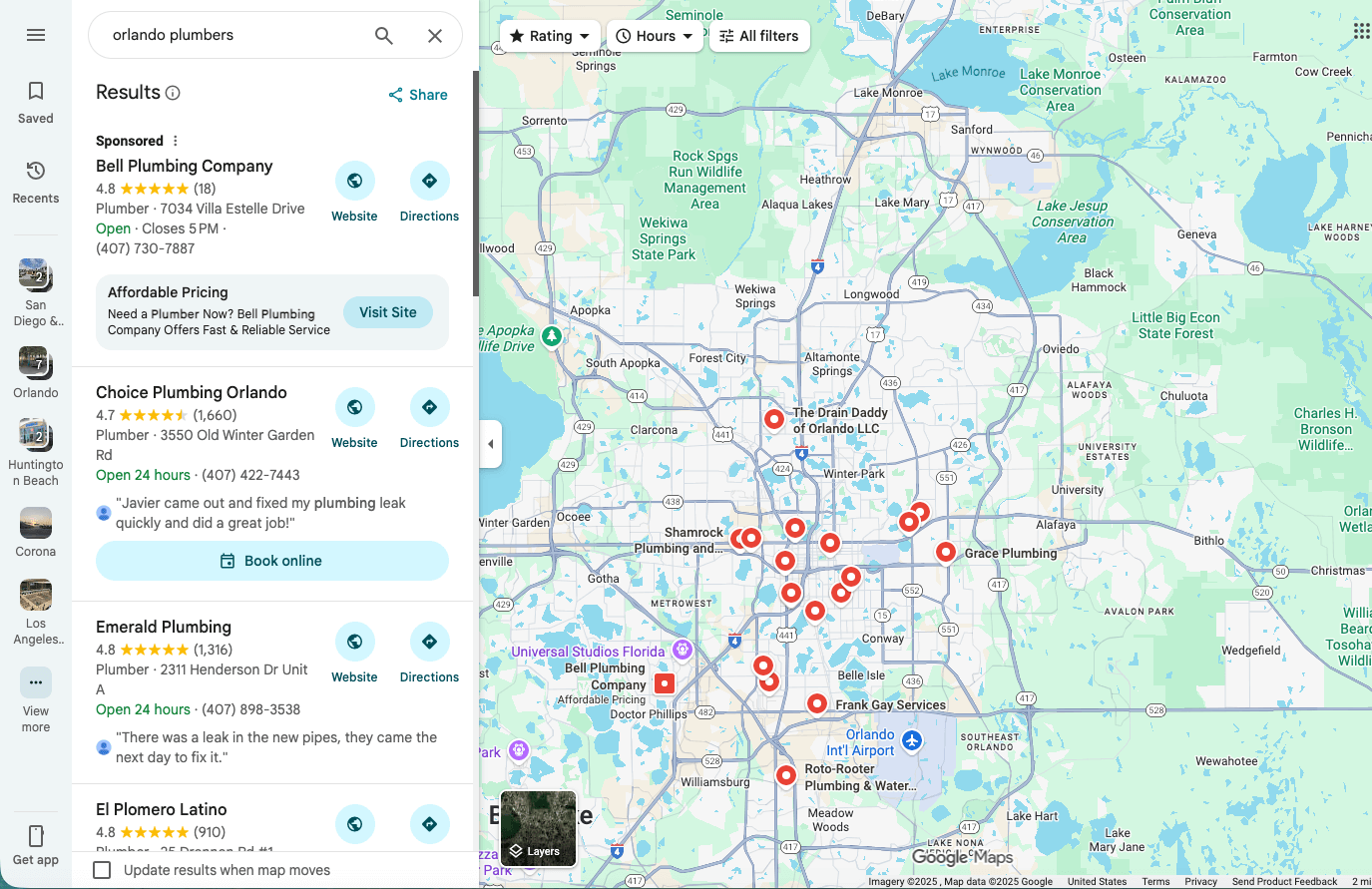
The businesses winning local search in 2026 aren't trying to rank for "Orlando plumber." They're owning Winter Park first, then expanding from there.
Picture two plumbing companies operating right here in Central Florida.
Company A has been fighting for years to rank for "Orlando plumber." They spend thousands of dollars every month on SEO, trying to beat out dozens of massive competitors across the entire metro area. They are competing with businesses twenty miles away, fighting an uphill battle that drains their budget.
Company B took a different approach. They focused everything on College Park first. Their website has a dedicated College Park plumbing page. Their reviews mention College Park by name. Their Google Business Profile description highlights their College Park service area.
Guess which company gets more calls?
It is almost always Company B.
Here is the secret most business owners miss: Google personalizes local results at the neighborhood level, not just the city level. When someone searches for a "plumber near me" from their kitchen in Winter Park, they get a completely different set of results than someone searching from their living room in Dr. Phillips.
If you are trying to rank for the whole city, you are spreading your resources too thin. You are trying to be everything to everyone. The smart play is to dominate specific micro-markets within a four to five-mile radius of your shop or home base. Once you own that territory, you move to the next one.
This strategy is called Micro-Market SEO, and it is the most effective way for service businesses to win in a crowded market like Orlando.
How Google Actually Ranks Local Businesses
To understand why this strategy works, you have to understand how Google decides who gets the top spots in the map pack. It is not just about who has the most reviews or the nicest website.
Proximity is the #1 local ranking factor in Google's algorithm.
This means the physical distance between the searcher and your business is the most important thing Google looks at. You cannot change your office location every week, but you can maximize your visibility within the radius where you actually have a fighting chance.
The 4-5 Mile Radius Reality
Most local service businesses serve customers within a 4-5 mile radius of their location. This is simply a fact of geography and traffic. Google knows this. Their data shows that consumers want providers who are nearby. They do not want to wait for a technician to drive an hour across town on I-4 during rush hour.
Because Google prioritizes user experience, they tighten the search radius. If you are a roofer in Altamonte Springs, trying to rank for "Orlando roofing" puts you in direct competition with companies in Lake Nona. That is a losing battle because Google will almost always show the Lake Nona customer a Lake Nona roofer.
When you accept this 4-5 mile reality, you stop wasting money trying to rank in areas where you have no proximity advantage. Instead, you double down on the areas where the algorithm is already biased in your favor.
The Micro-Market Advantage
Micro-market SEO is simply the practice of focusing your search engine optimization efforts on specific neighborhoods within your service area rather than broad city names.
It sounds simple, but the impact on your bottom line is massive.
Why Neighborhood Searches Convert Better
There is a big difference in intent between someone searching for "electrician" and someone searching for "College Park electrician."
The first searcher might be looking for a job. They might be looking for a definition. They might be looking for a general price range.
The second searcher has a problem right now. They want someone local. They want someone who knows their area.
Data backs this up. Neighborhood-specific searches convert 3x higher than generic city searches.
When a potential customer uses a neighborhood name, they have already decided they want a local expert. They are not window shopping. They are ready to hire. By targeting these terms, you are getting in front of the most qualified leads in the market.
Consider that 46% of all Google searches have local intent. That is nearly half of all activity on Google. People are looking for things nearby. By narrowing your focus to the neighborhood level, you align your business perfectly with what these users are looking for.
The AI Bypass
You have probably seen the new AI Overviews at the top of Google search results. These AI-generated summaries push traditional organic results further down the page, making it harder to get clicks.
However, there is a loophole.
AI Overviews appear less frequently on hyper-local "near me" or neighborhood-specific searches. In fact, they only appear about 7% of the time for these queries.
When someone types in a broad term like "AC repair Orlando," Google often triggers an AI Overview to explain how AC repair works or list aggregate pricing. But when someone types "AC repair Baldwin Park," Google treats it as a navigational query. They assume the user wants a list of businesses, so they skip the AI fluff and show the traditional Map Pack and organic listings.
Targeting neighborhoods is one of the best ways to "AI-proof" your SEO strategy.
Mapping Your Micro-Markets
You cannot target every neighborhood at once. You need to pick your battles. The goal is to identify the pockets of Orlando where you can win, establish dominance there, and then expand.
Start With Your Highest-Value Areas
Look at your customer data from the last twelve months. Where did your best jobs come from?
You are looking for the intersection of three things:
- Proximity: Areas close to your physical location.
- Profitability: Neighborhoods with higher ticket values or better profit margins.
- Traction: Areas where you already have a few happy customers.
If you are based in Maitland but you drive to Kissimmee for $50 service calls, you are losing money. But if you realize that your most profitable roof replacements consistently come from Windermere, that is a clear signal.
Orlando Neighborhoods to Consider
Central Florida is a collection of distinct communities. People here identify with their neighborhood. If you live in Thornton Park, you do not just say you live in "Orlando." You say Thornton Park.
Here are some high-value micro-markets to consider targeting, depending on where your shop is located:
- Winter Park: High property values and older homes often needing service upgrades.
- Dr. Phillips: Established families and larger homes.
- College Park: A tight-knit community that loves supporting local businesses.
- Lake Nona: Rapidly growing with newer construction but high demand for upgrades and maintenance.
- Mills 50: Historic bungalows that often need plumbing and electrical attention.
- Baldwin Park: A specific demographic that values convenience and responsiveness.
- Windermere: Luxury estates requiring specialized service.
- Downtown Orlando: High-density condos and commercial work.
- Audubon Park: Eco-conscious homeowners who value green solutions.
Don't try to hit them all. Pick the two or three that make the most sense for your business right now.
Implementing Micro-Market Strategy
Once you have chosen your target neighborhoods, you need to signal to Google that you are the authority in those specific areas. You do not need to trick the algorithm. You just need to be clear.
Google Business Profile Optimization
Your Google Business Profile (GBP) is your digital storefront. It needs to scream "local" to the algorithm.
First, define your service areas accurately. Do not just put "Orlando, FL." Add the specific neighborhoods you serve. You can add up to 20 service areas. Use them. Add "Winter Park," "Delaney Park," and "Conway."
Second, work these location names naturally into your business description. Instead of saying "We serve all of Central Florida," try "Proudly providing electrical services to homeowners in Winter Park, Audubon Park, and downtown Orlando."
Website Content
Your website needs to back up what your GBP is saying. If you want to rank for "Winter Park plumber," you need a page on your site about plumbing in Winter Park.
Do not just copy and paste your home page and swap the city name. That is spammy, and Google hates it.
Create unique service pages that speak to the specific needs of that neighborhood.
- Talk about the housing stock. Are the homes in that area mostly historic 1920s bungalows with cast iron pipes? Mention that.
- Reference local landmarks. Mention that you are just down the road from Lake Eola or around the corner from the Dr. Phillips Center.
- Show local proof. Embed a map of that specific neighborhood.
For example, a heading like "AC Repair in Winter Park" is better than just "AC Repair." It tells both the user and the search engine exactly where you operate.
Review Strategy
Reviews are a goldmine for local SEO, but only if they are specific. A review that says "Great job, highly recommend" is nice. A review that says "Company B did a great job fixing the leak at our home in College Park" is powerful.
When customers mention their location in the review text, it creates a massive relevance signal for Google. It proves you actually work in that area.
Train your techs to ask for this. When they finish a job, have them say, "When you leave a review, would you mind mentioning that we came out to Lake Nona? It helps our neighbors find us." Most customers are happy to help.
Local Citations
Citations are mentions of your business name, address, and phone number (NAP) on other websites. Think Yelp, Angi, and the Yellow Pages.
You want to make sure your business is listed in neighborhood-specific directories if they exist. Many neighborhoods like Baldwin Park or Celebration have their own community websites or HOA newsletters. Getting listed there is a strong signal of local authority.
Ensure your name, address, and phone number are consistent across every single listing. Confusion kills rankings.
The Expansion Playbook
You might be thinking that limiting yourself to a few neighborhoods limits your growth. It is actually the opposite. Narrowing your focus builds momentum that allows you to expand faster and more cheaply.
Signs You're Ready to Expand
You should not move to a new micro-market until you have won the first one. How do you know when you are winning?
- Rankings: You are consistently showing up in the top 3 map results for "[your service] + [neighborhood]" searches.
- Reviews: You have multiple 5-star reviews specifically mentioning the target area.
- Leads: You are getting a steady flow of calls from that neighborhood without having to pay for ads.
Once you hit these benchmarks, your authority is solid. You have a fortress. Now you can march to the next town.
Systematic Growth
The goal is to replicate what worked. If you crushed it in College Park, take that same playbook to Winter Park.
Add one new neighborhood per quarter. Build the page. Update the service area. Get the reviews. Rinse and repeat.
This method prevents you from overextending. It keeps your marketing budget focused. It ensures you are always fighting a winnable battle.
The Bottom Line
The days of ranking #1 for broad, city-wide terms with a basic website and a few keywords are over. The competition is too fierce, and the algorithm is too smart.
But the opportunity at the neighborhood level is wide open. Most of your competitors are too lazy or too distracted to do this work. They are still chasing the "Orlando" volume while you are quietly scooping up the highest-converting customers in the best neighborhoods.
Don't try to be the best plumber in Orlando. Be the best plumber in College Park. Then Winter Park. Then Baldwin Park. Dominate neighborhood by neighborhood, and eventually you own the city.
Ready to dominate your neighborhood?
We put together a complete guide on micro-market strategy for Orlando service businesses. It covers how to identify your best neighborhoods and build geographic dominance systematically.
Download the Complete Micro-Market Guide
Want help building a micro-market strategy for your business? We work with service businesses across Central Florida to dominate their local markets neighborhood by neighborhood.