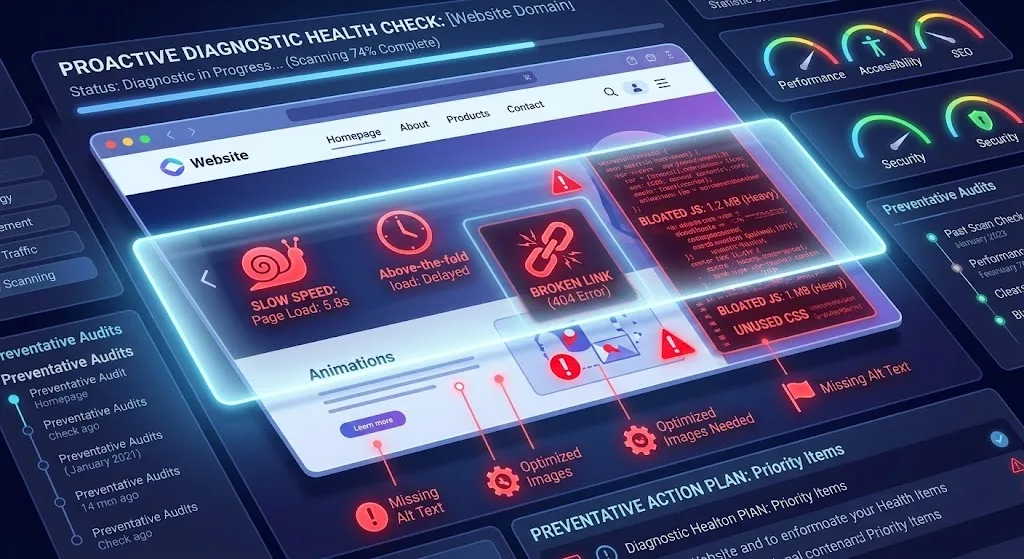
Your website could be quietly costing you customers right now, before your traffic even drops. Most Orlando small business owners don't realize their site is working against them until rankings fall off a cliff. This post covers the proactive warning signs to watch for, so you can fix them before they become expensive problems. If you'd rather have an expert take a look, call REK Marketing and Design at (407) 500-0102 for a free audit.
What Are the Biggest Red Flags That a Website Is Hurting Your SEO?
A website hurts your SEO when it creates friction for both users and search engines. Slow load times, thin content, poor mobile performance, and confusing navigation all send negative signals to Google. The December 2025 Core Update made these signals count more than ever. Catching them early, before traffic drops, is the difference between a quick fix and a months-long recovery.
We've audited hundreds of sites for Central Florida businesses, and the same patterns show up again and again. Here's what to look for.
Is Your Site Fast Enough to Pass Google's Standards?
Google uses page speed as a direct ranking signal, and the bar keeps rising. A site that takes longer than 3 seconds to load on mobile loses roughly 53% of visitors before they ever see your content. That's not a ranking problem. It's a revenue problem.
We ran Google's PageSpeed Insights tool on two Orlando businesses in the same market. A custom-coded REK client scored an 82 with a Largest Contentful Paint (LCP) of 4.1 seconds. Their WordPress competitor scored a 48 with an LCP of 15.1 seconds. Four times slower. That gap directly affects who ranks on page one and who doesn't.
The December 2025 update weighted Core Web Vitals more heavily than previous updates. Check your own score at Google PageSpeed Insights. A score below 50 on mobile is a serious red flag. Scores between 50 and 70 still need work. Sites built on bloated WordPress templates with stacked plugins rarely pass these benchmarks without a complete rebuild.
Our web design services use hand-coded HTML5 and CSS3 for exactly this reason. No plugins, no bloat, no slow-loading templates dragging your rankings down.
Does Your Content Actually Demonstrate Expertise?
Generic content doesn't rank anymore. Full stop.
Google's E-E-A-T framework, which stands for Experience, Expertise, Authoritativeness, and Trustworthiness, was tightened significantly after the December 2025 Core Update. Pages without clear author attribution, original insights, or real-world specifics now face serious ranking challenges.
We see this regularly with businesses in Dr. Phillips and Lake Nona. A well-designed site with thin service descriptions and no supporting content simply can't compete against a competitor who publishes detailed, experience-driven pages that answer real customer questions.
Ask yourself these questions about your current content:
- Does each page answer a specific question your customers actually search for?
- Does it include specific numbers, prices, or timeframes rather than vague claims?
- Is there a real person's name and credentials attached to the content?
- Does it reflect something only a local expert would know?
If you answered "no" to most of these, your content is likely one of the main reasons your site isn't ranking the way it should. This is one of the most common website hurting SEO signs we find with Orlando, Florida businesses during our audits.
Are High Bounce Rates Signaling a User Experience Problem?
A bounce rate above 70% on a service page is a warning sign. It means people land on your page and leave immediately without clicking anything. Google interprets that as a signal that your page didn't answer the query.
High bounce rates usually come from one of three sources: slow load speed, content that doesn't match search intent, or a layout that's hard to read on mobile. Since over 60% of local searches happen on phones, a site that looks fine on a desktop but frustrates mobile users will bleed rankings slowly over time.
The fix isn't just visual. You need your most important information, your service, your location, and your call to action, visible without scrolling on a phone screen. Visitors near the Church Street area or Thornton Park searching for local services on their lunch break won't wait for a cluttered page to load. They'll click back and choose your competitor.
Are You Optimized for AI Overviews and Local Authority?
AI Overviews now appear for roughly 29% of Google searches. Being cited in one increases clicks by about 35%. Getting cited requires content that directly answers questions in the first 50 to 70 words of each section, uses specific data points, and signals real local expertise.
This is what we call the Florida Factor. Local authority comes from specificity. Mentioning that you serve businesses along Semoran Boulevard, citing Orange County permit requirements, or referencing the challenges that Central Florida's humidity creates for specific industries all tell Google your content is grounded in real, local experience. Generic content written without that context gets filtered out.
These same signals matter for traditional search rankings. Businesses that optimize for AI citation are also building the trust signals that help them rank in organic results. Our SEO services are built specifically for this kind of local authority development.
Is Your Site Passing Google's Mobile and Technical Benchmarks?
Beyond speed, there are several technical issues that quietly suppress rankings. Most small business owners never see them because they don't show up visually on the site. They only show up as flat or declining traffic over time.
Common technical issues we find in audits:
- Crawl errors: Pages Google can't access or index
- Missing or duplicate meta titles: Especially common on sites with many service pages
- No structured schema markup: Schema helps both Google and AI platforms understand your business and content
- Broken internal links: These dilute page authority and frustrate users
- No SSL certificate: Sites without HTTPS are flagged as "not secure" and face ranking penalties
- Unoptimized images: Large image files are one of the leading causes of slow load times
A site that checks all of these boxes isn't just better for SEO. It's better for every person who visits it. That's the whole point.
This is one of the most consistent website hurting SEO signs for Orlando, Florida, businesses operating on older or template-based sites. The issues compound over time. A missing schema tag in 2023 becomes a significant authority gap by 2026 when AI-driven search relies on structured data to understand and recommend local businesses.
How to Fix Your Website's SEO Before Traffic Drops
Here's a practical starting checklist to run through this week:
- Run Google PageSpeed Insights on your homepage and your top service page. If either scores below 60 on mobile, site speed is costing you rankings.
- Check your bounce rate in Google Analytics. Filter by mobile users. A rate above 70% on service pages needs attention now.
- Read your own content out loud. If it sounds like a brochure from 2015 or a generic AI summary, it won't rank. Rewrite key pages with specific details, local references, and real answers to customer questions.
- Look for author attribution. Every blog post should have a real name and a short bio attached to it. Anonymous content signals low trust.
- Test your site on a phone. Not a desktop browser with a small window. An actual phone. Can you find the phone number and service information without scrolling? If not, fix the layout.
- Request a full technical audit. Crawl errors, missing schema, and duplicate content don't surface unless you specifically look for them.
You don't need to fix everything at once. Prioritize speed and mobile experience first, since those have the most direct impact on both rankings and conversions. Content and technical cleanup can follow.
These steps address the most common website hurting SEO signs that Orlando, Florida businesses overlook until traffic drops 20 to 30% in a single quarter. Prevention costs far less than recovery.
Ready to Find Out What's Holding Your Site Back?
A site audit takes 30 seconds to request and gives you a clear picture of exactly where your site stands. If you'd rather talk through what you're seeing, the team at REK Marketing and Design has been working with Central Florida businesses for over 22 years. Call (407) 500-0102 and we'll take a look at what's going on with your site.