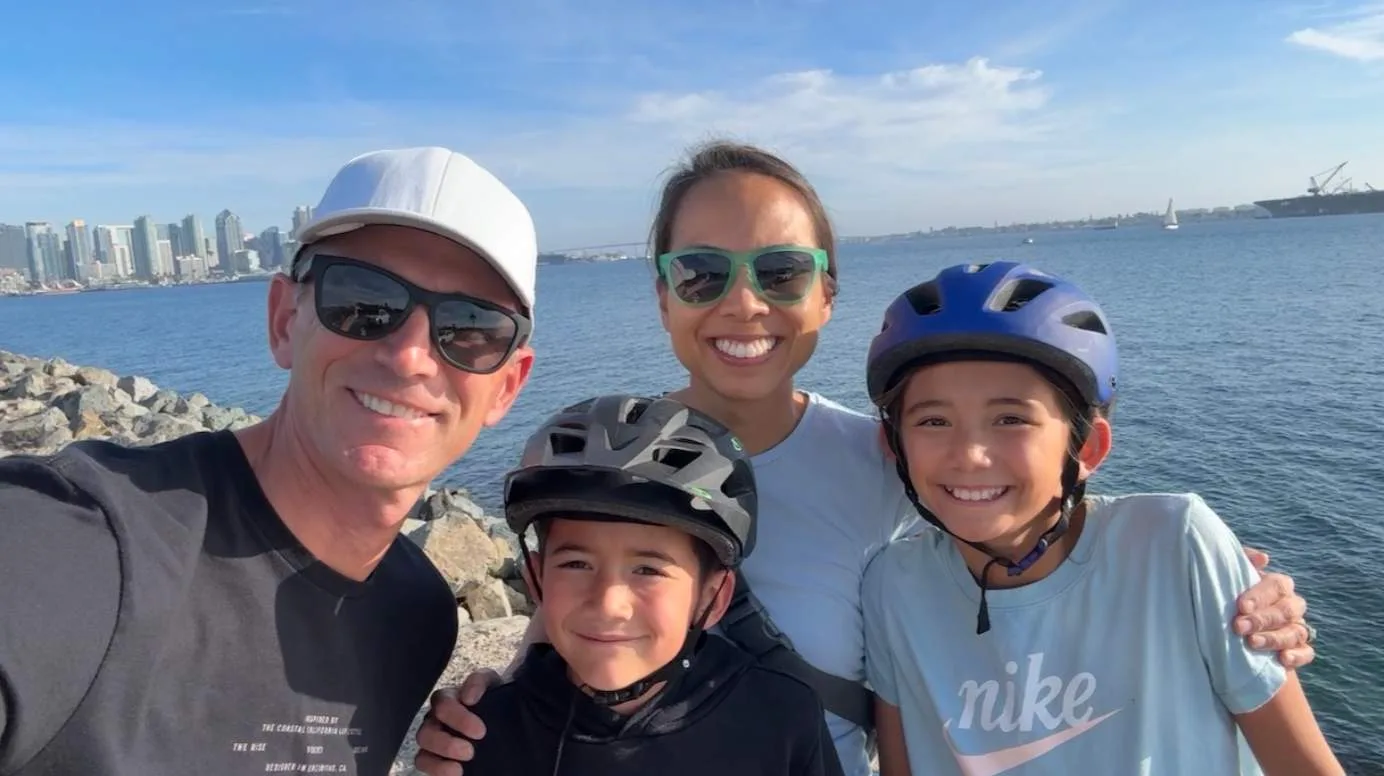
REK designer and writer Donna sat down with Tom Klingebiel to find out what's actually shifting in local search and what local businesses need to do about it.
I've been the designer and writer at REK Marketing & Design for years, which means I spend a lot of time making websites look good and read well. Tom Klingebiel is our Head of Marketing & Growth, and he spends a lot of time making sure those websites actually get found. We sit on different sides of the same table, and lately I've been curious about what he's seeing out there. So I asked him.
What came out of that conversation was worth sharing. Tom has been in marketing for over two decades, and most recently in local SEO. He and business partner Dave Lertola took over REK recently and have been making massive changes. Dave handles client relationships from outside Philadelphia, Tom runs strategy from San Diego. They met through Tom's wife, bonded over a shared drive to help small businesses compete, and now serve tattoo shops, law firms, HVAC companies, beauty salons, roofers, landscapers, and everything in between.
I wanted to understand what's actually changing in 2026. Not the buzzword version, but the real version. Here's what Tom told me.
I Asked Him: Is AI Search Really as Big a Deal as Everyone Says?
Short answer: yes. And Tom thinks most local businesses are underestimating how fast it's moving.
"AI search isn't coming," he told me. "It's already here. When someone asks ChatGPT or Google's AI Mode 'best tattoo shop near me' or 'how much does a divorce attorney cost in San Diego,' they get an answer before they ever see a list of websites. Your business either shows up in that answer or it doesn't. There's no page two."
The numbers back him up. According to BrightLocal's 2026 Local Consumer Review Survey, 45% of consumers now use AI tools like ChatGPT, Gemini, and Perplexity to find local services. That number was 6% one year ago. Google's AI Mode crossed 75 million daily active users earlier this year, and that's not a beta test anymore. That's a mainstream search surface.
"The businesses showing up inside it aren't getting there by accident," Tom said. "They're getting there because their websites and entire brand identity across all channels and platforms are built and structured in a way that AI systems can read, understand, and cite."
He believes the traditional Google search experience, the ten blue links and the local pack, will look very different by the end of 2026. "Most local search interactions are going to start with a conversational AI response or even become predictive. The businesses that have prepared for that are going to be in a very different position than the ones still optimizing for search as it looked in 2023."
So I Asked: What Does That Actually Mean for a Local Business's Website?
This is where it got practical. Tom's take is that most local business websites are built to describe a business, not to answer questions. And that distinction matters more now than it ever has.
"AI systems don't rank websites the way traditional Google search does," he explained. "They extract answers from pages. They pull sentences, sections, and structured content that directly responds to what someone asked. If your website is a collection of service descriptions, a few stock photos, and a contact form, it's not giving AI anything useful to cite. You become invisible by default."
At REK, every website they build is structured with that in mind. Heading structure. FAQ sections. Content that answers the real questions customers are asking: how much does this cost, what should I watch out for, how long does this take.
"That kind of content isn't just good for AI," Tom said. "It's what converts visitors into calls. But it's also exactly what gets you cited when someone asks an AI assistant for a recommendation."
He's blunt about what doesn't work. "Generic doesn't work. Vague doesn't work. 'We provide quality services to the greater Orlando area' tells a customer nothing and tells an AI even less."
Then I Asked the Question I Wondered About as a Designer: Does the Way a Site Is Built Actually Matter?
This one was personal for me. REK has always built custom-coded HTML sites, no WordPress, no templates. I've always known that was about quality and control. But I wanted to understand why Tom thinks it's more important now than ever.
"Everyone is working on this right now," he said. "WordPress, the template platforms, the page builders, they're all trying to figure out how to position themselves for AI search. But when you're working around a platform's limitations, you're always a step behind. A clean, custom-coded site with proper semantic HTML, schema markup, and clear content organization doesn't have that problem. We're not waiting on anyone."
He puts it simply: "We don't want unnecessary code sitting between our work and the systems that are increasingly responsible for recommending local businesses. Full control isn't just a preference. It's a competitive advantage."
Finally, I Asked What He Wishes More Business Owners Understood
Tom had a lot to say here. This is clearly something he feels strongly about.
"A lot of agencies are using AI to generate content faster, and some of them are doing it without any real strategy or human oversight. The result is a flood of generic, templated blog posts and service pages that read like they came from the same prompt...because they did. Of course we use AI in our day-to-day work. It makes us more efficient. But you can't solely rely on it. It's a balance."
He pointed to Google's March 2026 core update, which impacted 73% of websites and actively penalized thin, AI-generated content while rewarding original expertise and real-world experience. "That's not a coincidence," he said. "That's direction from Google on where they're going. Business owners need to ask their agency how content is being created, who's reviewing it, and whether it's actually specific to their business and their market. Because if it isn't, there are real consequences."
On the timeline question, how long SEO takes, he's equally direct. "SEO is a long game. It's consistent effort over time. If you're a newer business that needs leads this month, start with paid search and Local Services Ads while your organic presence builds. But start building your brand presence across every channel from day one: LinkedIn, Facebook, Instagram, YouTube. The more consistently you show up across platforms, the more AI systems understand who you are and what you do."
He wrapped it up the way he tends to, plainly. "We've been at this for 22 years. The fundamentals haven't changed. The landscape has. The businesses that treat their web presence as something to be actively managed, not set and forgotten, are the ones still generating leads five years from now."
I'm a designer. I think about how things look and how they read. But after this conversation, I'm thinking a lot more about how they get found. Turns out the two aren't as separate as I used to think.
Donna is the Designer and Writer at REK Marketing & Design, a custom web design and local SEO agency founded in 2003. REK serves local businesses of all kinds, from law firms and tattoo shops to contractors and landscapers, across Florida, San Diego, Philadelphia, and beyond.
Dave Lertola, REK's Operations partner, shares what he hears directly from business owners every day here.
Have questions about where your website stands? Call us at (407) 500-0102 or visit rekmarketing.com.