If you run a business in Orlando, Florida, your website needs to do more than just exist — it needs to show up when local customers search for what you offer. Google's December 2025 core update shifted how search results are ranked, and for small business owners across Central Florida, understanding the difference between local SEO and traditional SEO has never mattered more.
Not sure which approach is right for your business? Call REK Marketing and Design at (407) 500-0102 for a free consultation — we've helped hundreds of Orlando businesses get found online.
What's the Difference Between Local SEO and Traditional SEO?
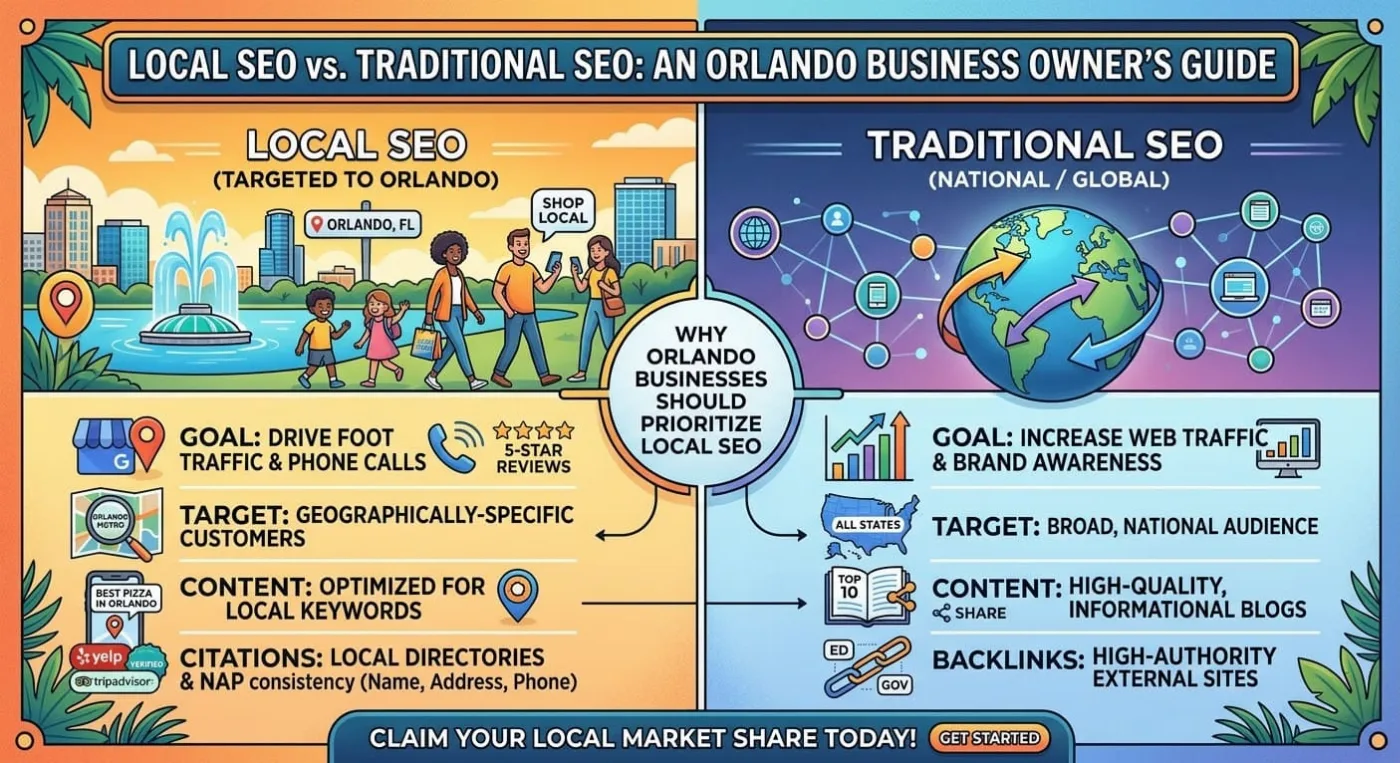
Local SEO focuses on ranking your business in geographically targeted searches — like "best plumber near me" or "HVAC repair Orlando." Traditional SEO targets broader, national, or industry-wide keywords without a geographic focus. For most small businesses in Central Florida, local SEO drives more direct leads because your customers are searching nearby, not nationwide.
Both approaches use content, technical optimization, and authority signals. But they prioritize different factors to reach different audiences. That distinction shapes every decision you make about your online presence.
Why "Near Me" Searches Are Winning in Orlando
Hyper-local searches are dominating Orlando's digital market. A customer in Winter Park searching "dentist near me" or someone in Lake Nona looking up "same-day AC repair" expects Google to serve them businesses within a few miles — not results from across the country.
According to data from REK Marketing's own client base here in Central Florida, local searches convert at a significantly higher rate than generic organic traffic. That makes sense. Someone searching "fence company Orlando" is ready to call. Someone searching "how does fencing work" is just browsing.
This is why our local SEO services are built specifically around intent-driven, location-based searches. Appearing in the Google Map Pack — the three business listings that show up at the top of local results — can increase calls and website visits by 50% or more.
How Do Local Citations Compare to Traditional Backlinks?
Traditional SEO relies heavily on backlinks from other websites to build domain authority. The more high-quality sites linking to yours, the more Google trusts your content. This strategy works well for national brands and e-commerce sites competing for broad terms.
Local SEO works differently. Instead of chasing backlinks from major publications, local businesses need citations — consistent mentions of your business name, address, and phone number across directories like Yelp, Google Business Profile, and local Chamber of Commerce sites. When your NAP data matches across 100+ directories, Google gains confidence that your business is legitimate and local.
Our team at REK Marketing and Design audits and cleans up citation inconsistencies for our clients regularly. We've seen businesses lose Map Pack rankings simply because their address was formatted differently across a handful of directories.
Does Your Google Business Profile Actually Affect Rankings?
Yes, directly and significantly. Your Google Business Profile is the single most powerful tool in local SEO. A fully optimized profile — with the right categories, services, photos, Q&A responses, and weekly posts — signals to Google that your business is active, credible, and relevant to local searches.
Traditional SEO has no equivalent. There's no Google Business Profile for a national software company targeting generic keywords. That's one reason why local SEO for service businesses in Orlando tends to produce results faster — typically 3 to 6 months — compared to 6 to 12 months or longer for traditional, nationally competitive SEO campaigns.
How Should Your Content Strategy Differ for Local vs. Traditional SEO?
Traditional SEO content often targets broad industry keywords: "how to choose a roofing material" or "benefits of metal roofing." That content can attract readers from anywhere in the country, which works well for informational or e-commerce sites.
Local content strategy goes narrower and deeper. A roofing company in Orlando should be targeting searches like "roof repair after hurricane season Orlando" or "tile roof replacement Winter Park." These searches reflect real local pain points — and our clients in Central Florida know that hurricane season (June through November) causes a surge in roof damage claims every year. Generic content won't capture that traffic. Orlando-specific content will.
Our SEO services include creating service pages and location pages that directly address what your customers in specific neighborhoods are actually searching for.
What Do E-E-A-T and AI Overviews Mean for Local Businesses?
Google's E-E-A-T framework — Experience, Expertise, Authoritativeness, and Trustworthiness — now weighs heavily on how content ranks, especially after the December 2025 core update. For local businesses, this means your website needs to demonstrate real-world credibility: customer reviews, specific local experience, and content that proves you know your market.
AI Overviews now appear in roughly 29% of Google searches. Getting cited in an AI Overview can boost clicks by up to 35%, even when users don't visit your page directly. Structured content that answers questions quickly and specifically — with real numbers and local context — is what AI systems pull from.
For a small business in Orlando, this is actually good news. Local search AI Overviews appear less frequently (around 7% of local searches), giving businesses with strong local SEO a real edge over competitors who aren't paying attention to these signals.
How Do You Measure Success in Local SEO vs. Traditional SEO?
Traditional SEO measures success through organic rankings, domain authority growth, and national traffic volume. These are useful metrics for national brands but can feel abstract for a small business owner trying to track real revenue.
Local SEO success looks different. You're tracking Map Pack rankings for specific Orlando-area searches, call volume from Google Business Profile, direction requests, foot traffic trends, and local lead generation. These numbers connect directly to customers walking through your door or calling your business.
We've seen an Orlando recycling company grow organic users by over 19,000% year over year, and an Orlando mental health practice achieve over 12,000% organic traffic growth — both through focused local SEO strategies, not broad national campaigns.
Should Your Orlando Business Use Both Strategies?
For most small businesses across Central Florida, local SEO should come first. If you serve customers within a specific geographic area — whether that's downtown Orlando, Lake Nona, or the communities around Winter Park — local search is where your customers are looking.
That said, traditional SEO principles still apply. Strong on-page content, fast load times, technical site health, and quality backlinks all support your local rankings too. The strategies aren't opposites. They reinforce each other. The key is knowing which one deserves more of your attention and budget given your business model.
Start with the question: "Are my customers searching locally or nationally?" If the answer is locally, prioritize your Google Business Profile, local citations, and neighborhood-specific content before chasing national keywords.
Get Your Local SEO Strategy Right the First Time
Sorting out the difference between local SEO vs. traditional SEO as an Orlando, Florida business owner doesn't have to be confusing. The short version: if your customers are in Central Florida, your SEO strategy should be too.
REK Marketing and Design has been helping Orlando businesses rank locally for over 22 years. We're not a faceless agency — we're a team based right here in Orlando, and we understand the local market because we work in it every day. Call us at (407) 500-0102 to get a free SEO audit and find out exactly where your business stands.