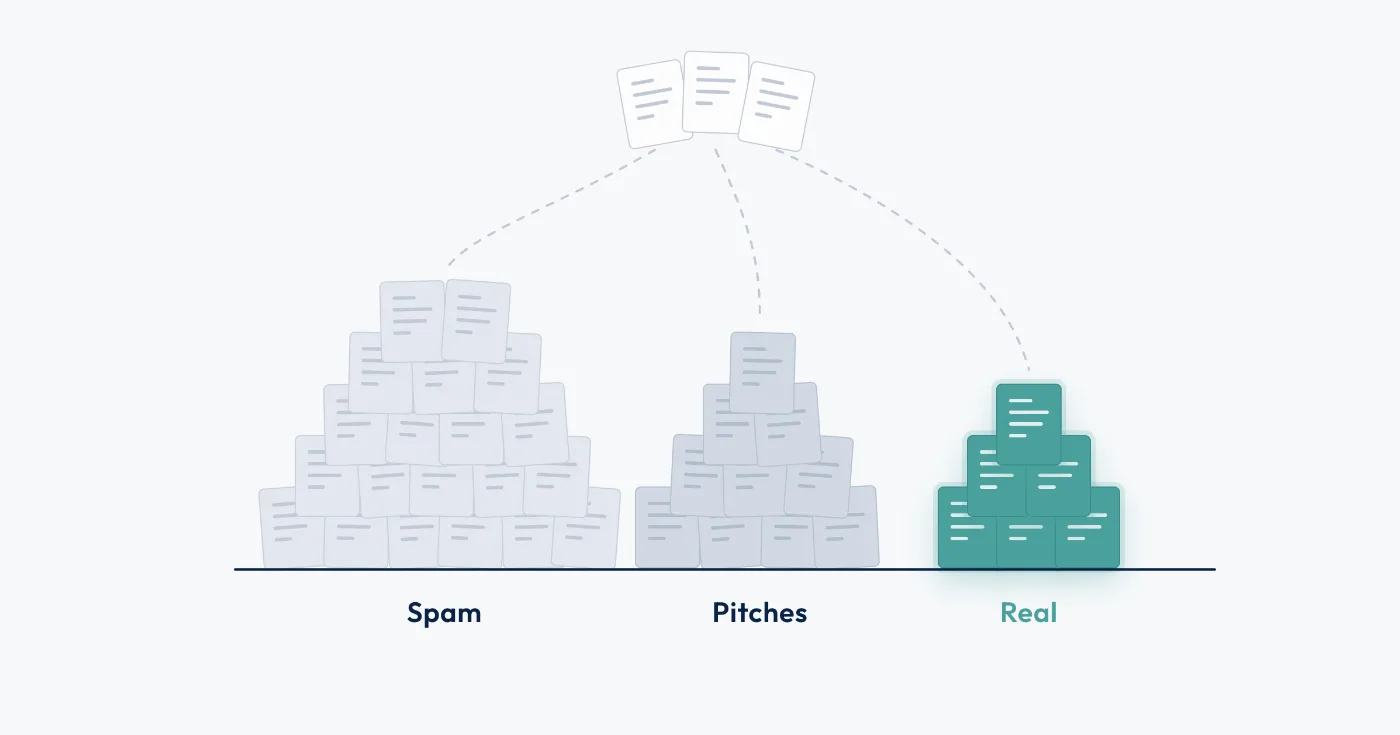
Back in November 2025 we started keeping a copy of every single form submission that came through our own website. A few weeks ago I finally sat down and read all of them, one by one, and sorted them into piles. I expected it to be bad. I didn't expect this.
From November 11, 2025 through September 30, 2026, our site took in 508 form submissions. 63 of them were real potential customers. That's 12.4%, about 1 in 8.
The rest? 206 were spam (41%), 119 were our own team testing the forms (23%), and 102 were other vendors trying to sell us something (20%). The last 18 were duplicates, unclear, or existing clients. Here at REK Marketing and Design we manage marketing for about 90 small businesses, and I'm sharing this because almost nobody counts leads this way, and the gap between form fills and actual leads changes just about every marketing decision you'll make.
Why Does Your Website Get Traffic but No Leads?
A lot of the time it does get leads and they just drown. Here's a quick exercise: pull up your last 30 form submissions and actually read them. If your inbox looks anything like ours, a good chunk is bots and another chunk is marketers pitching you their services, and buried somewhere in the pile is the one real inquiry, and if you reply to it two days later it's gone.
Sales folks love the five minute rule, answer a new lead within five minutes or it goes cold. I'd frame it a little differently. When only one submission in eight is real, the whole game is spotting that one fast and giving it your full attention. Being honest about the other seven is what makes that possible.
Does the 2% to 5% Conversion Benchmark Mean Anything?
Google's AI Overview, and pretty much every marketing blog, will tell you a standard website should convert 2% to 5% of visitors into leads. Nobody ever says what counts as a lead. Those benchmarks are built on form fills, and our data says form fills overstate real inquiries by a lot.
If we set aside our own internal testing (we rebuilt our forms in 2026 and tested them way more than a normal business would), 63 of 389 outside submissions were real. About 1 in 6. So when a report tells you your site converts at 3%, the question I'd ask is: 3% into what?
What Did Google Analytics Say vs What Was True?
Here's a test worth running on your own analytics. Take the months you can verify by hand and put your GA4 lead events next to the real prospects from your inbox. For February through September 2026, our hand count was 470 submissions and 44 real prospects, and the GA4 event count for the same months sat far above both.
That gap is normal, and it has two causes we see all the time in the analytics setups we review. First, GA4 counts configured events, so a form submission event fires for spam, vendor pitches and test fills exactly the way it fires for a real customer. Second, event setups drift: Create event rules quietly copy events, tags double fire, and nobody notices, because the number only ever drifts in the direction that looks healthier.
A GA4 key event is a conversion event. It's not a lead until a human reads it and says so, and any report that treats the two as the same thing is flattering you.
How Do You Count Leads Honestly?
- Keep a copy of every submission somewhere you can actually read it, an inbox or a simple log, separate from the analytics event.
- Sort them once a month: real, spam, vendor pitch, internal test, duplicate. Takes us under an hour.
- Separate your form types. A careers form and a contact form measure totally different things, and a booking form isn't a lead form at all.
- Record where each real lead came from, the page and the channel, from day one. It's the cheapest item on this list and the one almost everyone skips, and without it you can't say which marketing actually produced the lead.
- Watch the phone. Most of our real new business doesn't come through the form at all, it comes by phone or a direct email, and no form dashboard will ever show you that.
Is It Worth Paying for Leads?
You can't answer that until you know your real cost per real lead. If you're paying for traffic and counting every form fill, your cost per lead looks eight times better than it actually is, and every budget decision after that inherits the error.
And look, form leads do close. Two of our 63 became paying clients (an asphalt paving company and a ground penetrating radar company), and that count might even be low, since we only counted the ones our notes flagged. Forms aren't worthless. You just have to count them honestly so you know what each real one costs you.
What Does This Mean for Your Website?
Build forms worth trusting: spam protection that works quietly, a short field list, and a weekly test submission to make sure they still fire. That last one matters more than people think. Forms fail silently, we've watched it happen on sites we review, and the only symptom is a quiet stretch that looks like slow season. A five minute test every week catches it. If you run a custom-coded site, this is cheap insurance.
FAQ
How Many Leads Should My Website Get?
There's no universal number, and anyone quoting one is guessing at your business with somebody else's math. On our own site, a typical month produced anywhere from 2 to 10 real prospects (November 2025 to September 2026). Know your own real number first. Then work on improving it.
What Counts as a Real Lead?
A plausible potential customer for the service you actually sell, judged by a human reading the submission. Not a bot, not a vendor pitching you, not your own test, not an existing client using the form to reach you.
Does Spam Mean My Forms Are Broken?
No, spam means your forms work and the bots found them, which happens to every site. The time to worry is when submissions go quiet. When a form breaks, total silence is usually the only symptom, and it looks exactly like a slow month.
Is a GA4 Key Event the Same as a Lead?
No. A key event is just a thing GA4 counts when a configured action happens. Form submission events count spam, vendor pitches and test fills right alongside the real inquiries, which is why the dashboard number almost always runs high.
Want to know what your forms are actually producing? That's a conversation we have with owners every week, and it usually changes where their next marketing dollar goes. Start with our free audit, call REK at (407) 500-0102, or send us a note through our contact page, and we'll help you find your real number.