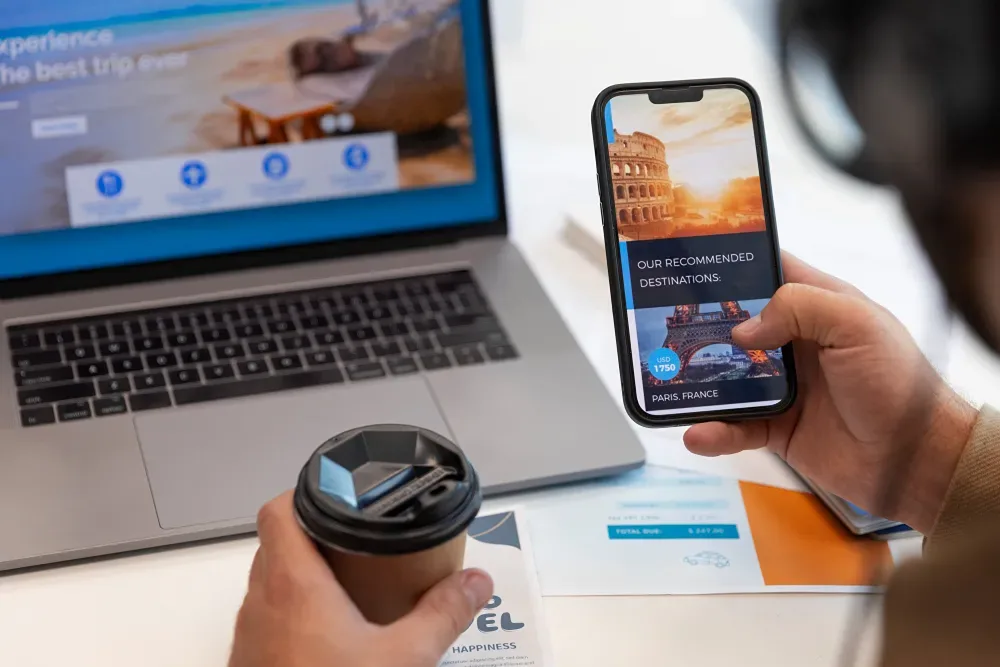
In 2024, nearly 60% of all website traffic in the United States comes from mobile devices. If you're running a business here in Central Florida, that number feels even higher. Between the millions of tourists navigating I-4 to find a restaurant and locals in Lake Nona searching for services on their phones, the reality is simple: if your site doesn't work perfectly on a smartphone, you're losing money.
Mobile-first design isn't just a buzzword; it's the standard for modern Orlando web design. It means designing the mobile version of your website before the desktop version, ensuring the most constrained environment works flawlessly first. This approach forces you to prioritize the most critical content, leading to faster load times and better user experiences (UX) across all devices.
At REK Marketing & Design, we've seen firsthand how a shift to mobile-first thinking transforms local businesses. It's not just about looking good on an iPhone; it's about capturing that immediate intent when a customer searches "best plumber near me" or "Winter Park coffee shops." This guide breaks down exactly what mobile-first UX means for your business and how to get it right.
What Is Mobile-First Design?
Mobile-first design is a strategy where web designers start the process by sketching and prototyping the smallest screen sizes first—usually smartphones—and then scale up to tablets and desktops. This is the opposite of the traditional "graceful degradation" method, where designers built complex desktop sites and tried to cram them onto small screens later.
Why does this matter? Because starting small forces discipline. You can't fit a 500-word history of your company and a massive hero video above the fold on a Samsung Galaxy. You have to choose what actually matters to the user.
According to Google's rigorous indexing standards, the mobile version of your website is now the primary version they use to rank your content [1]. If your mobile site is slow, clunky, or hard to read, your desktop site's beauty won't save your SEO rankings.
Why It Matters for Orlando Businesses
Think about the unique landscape of our city. We have over 74 million visitors annually. When a family is standing in line at a theme park or walking around Lake Eola, they aren't pulling out laptops to find a dinner spot. They're on their phones.
For locals in neighborhoods like College Park or Baldwin Park, the behavior is the same. If someone's AC breaks in August, they grab their phone to find a repair service. If your site takes 5 seconds to load or the "Call Now" button is too small to tap, they bounce to your competitor. In our experience, local service pages that take longer than 3 seconds to load on mobile see bounce rates jump over 30%.
Key Elements of Mobile-First UX
What actually makes a site "mobile-first"? It's more than just shrinking images. It requires specific technical and design choices that prioritize speed and usability.
Responsive vs. Adaptive Design
Responsive design means your website layout adjusts fluidly to fit any screen size, from a massive desktop monitor to a tiny iPhone SE. Elements stack, resize, and reorder automatically. We've helped local businesses in Doctor Phillips move from static sites to fully responsive layouts, and the difference in user retention is immediate.
However, mobile-first goes a step further than just "responsive." It considers the context. A desktop user might want to read your latest 2,000-word blog post. A mobile user often wants your phone number, your address, or your pricing immediately. A true mobile-first Orlando web design anticipates these needs.
Touch-Friendly Navigation
Have you ever tried to tap a menu link on a phone and accidentally hit the wrong one because the buttons were too close together? That's a failure of touch-friendly design.
Fingers are much less precise than mouse cursors. Apple's interface guidelines recommend a minimum target size of 44x44 pixels for tappable elements. For navigation, this usually means ditching the complex mega-menus used on desktops in favor of:
- Hamburger Menus: The three-line icon that expands into a full menu.
- Sticky Bottom Bars: A navigation bar that stays at the bottom of the screen (easy for thumb reach) with core actions like "Home," "Search," and "Cart."
- Accordion Menus: Lists that expand when tapped, keeping the initial view clean.
Optimized Images and Media
High-resolution images look great on a 27-inch monitor, but they can kill your mobile load times. A 4MB image might take 10 seconds to load on a 4G connection in a spotty coverage area.
To fix this, we use modern image formats like WebP, which provides superior compression without losing quality. We also implement "lazy loading," which means images further down the page don't load until the user actually scrolls to them. This keeps the initial page load lightning fast.
Benefits of Mobile-First UX for Orlando Businesses
Investing in mobile-first Orlando web design isn't just about technical compliance; it delivers tangible business results.
Improved SEO Rankings
Google has used mobile-first indexing for years now. This means Googlebot primarily crawls your site with a smartphone agent. If your mobile site is missing content that your desktop site has, or if it's slow, your rankings will suffer.
A study by Search Engine Land confirmed that mobile-friendliness is a significant ranking factor [2]. For a competitive market like Orlando, where dozens of businesses might be fighting for the keyword "landscape design near me," having a faster, more mobile-friendly site can be the tiebreaker that puts you in the top three map pack results.
Enhanced User Engagement
Mobile users are impatient. Google data shows that 53% of visits are abandoned if a mobile site takes longer than three seconds to load. By prioritizing mobile UX, you reduce friction.
When we redesigned a site for a client in Winter Garden, focusing specifically on simplifying the mobile checkout process, their cart abandonment rate dropped by 15%. Users could easily tap through options, autofill their addresses, and pay with digital wallets like Apple Pay. The easier you make it, the more people stay.
Increased Mobile Sales
For e-commerce, the connection is direct. But even for service businesses, "sales" happen on mobile. A "sale" might be a phone call, a contact form submission, or a reservation booking.
Consider a restaurant in Mills 50. If their menu is a PDF that users have to pinch and zoom to read on a phone, they lose customers. If the menu is a mobile-responsive web page with a sticky "Book a Table" button, they get more reservations. Mobile-first design directly impacts your bottom line.
Implementing Mobile-First UX with REK Marketing & Design
We don't believe in templates. Every business in Orlando has different needs. A law firm downtown needs a different mobile strategy than a surf shop near the coast.
Our Approach to Mobile-First Design
Our process starts with data. We look at where your current traffic comes from. If 80% of your visitors are on mobile, we spend 80% of our design energy there.
- Content Audit: We identify the most crucial information your customers need.
- Wireframing: We sketch layouts for smartphone screens first, ensuring the hierarchy makes sense on a small display.
- Speed Optimization: We build on lightweight frameworks that prioritize code efficiency.
- Thumb-Zone Testing: We test designs to ensure critical buttons are within easy reach of a user's thumb when holding a phone one-handed.
Case Studies: Real Results
We recently worked with a boutique retail store in Winter Park. Their old site was beautiful on desktop but impossible to navigate on a phone. The text was tiny, and the "Add to Cart" button frequently glitching off-screen.
We rebuilt their site with a mobile-first approach. We increased font sizes to 16px minimum for readability, implemented a streamlined mobile checkout, and optimized their product images. Within three months, their mobile organic traffic increased by 40%, and mobile revenue doubled.
Another client, a roofing company serving Orange County, was struggling to get leads. Their contact form had 12 fields—fine for a desktop, terrible for a phone. We simplified the mobile form to 3 essential fields and added a "Click to Call" button that followed the user down the page. Their mobile conversion rate for leads increased by 200% in the first month.
Common Mobile UX Mistakes to Avoid
Even with good intentions, many business owners get mobile design wrong. Here are the pitfalls we see most often in Central Florida.
Pop-ups That Cover Content
Google penalizes "intrusive interstitials"—those pop-ups that cover the whole screen immediately after you land on a page. On a mobile device, these are incredibly frustrating because the "X" to close them is often tiny or hidden. If you must use a pop-up, make sure it covers only a small portion of the screen and is easy to dismiss.
Unreadable Font Sizes
If a user has to pinch-to-zoom to read your "About Us" page, you've failed. Text should be legible without zooming. We recommend a base font size of at least 16px for body text. Headings should be clearly distinct but not so massive that they take up the entire screen height.
Slow Server Response Times
Your design can be perfect, but if your hosting is cheap and slow, your mobile experience will suffer. Mobile devices often rely on cellular data, which can have higher latency than home WiFi. We ensure our clients use high-performance hosting that delivers content quickly, regardless of connection speed.
Future-Proofing Your Orlando Web Design
Technology changes fast. Mobile-first design puts you in the best position to adapt to what's coming next.
Voice Search Optimization
Mobile usage drives voice search. When someone says, "Hey Siri, find an Italian restaurant nearby," Siri looks for fast, mobile-friendly sites with structured local data. By building mobile-first, you're naturally aligning with the requirements for voice search optimization.
Dark Mode Support
More users are keeping their phones in "Dark Mode" to save battery and reduce eye strain. A modern mobile-first site should automatically detect a user's system preference and switch to a dark color palette if requested. This is a subtle touch that users appreciate and makes your brand feel premium.
Ready to Upgrade Your Mobile Experience?
If you're running a business in Orlando, you can't afford to ignore the mobile experience. Your customers are already looking for you on their phones. The question is: do they like what they see?
At REK Marketing & Design, we specialize in Orlando web design that converts. We don't just build websites; we build business tools that work for you 24/7. Whether you're in Lake Nona, downtown, or the suburbs, we know how to reach your local audience.
Don't let a clunky mobile site cost you customers. Contact REK Marketing & Design today for a consultation, and let's turn your mobile traffic into loyal customers.
Sources:
[1] Google Search Central. "Mobile-first indexing." Google Developers.
https://developers.google.com/search/docs/crawling-indexing/mobile/mobile-sites-mobile-first-indexing
[2] Search Engine Land. "Google Is Experimenting With Special Ranking For Mobile-Friendly Sites"
https://searchengineland.com/google-special-ranking-mobile-friendly-sites-208957