
About the Client
Evolve Counseling & Wellness is an Orlando-based therapy practice offering individual counseling, couples therapy, and specialized support for anxiety, trauma, and relationship issues. Like most small therapy practices, new clients came almost entirely through referrals and psychology directory listings. Organic search wasn't a channel. Not because it couldn't be, but because the site and strategy weren't built for it.
Quick Facts
| Client | Evolve Counseling & Wellness |
| Industry | Mental Health & Therapy |
| Location | Orlando, FL |
| Services | SEO Strategy, Custom Website Design, Content Marketing |
| Timeline | 12+ Months |
| Last Updated | March 2026 |
The Challenge
When REK took over their web presence, the site was barely registering in search. Monthly organic clicks were in the 30-50 range, average search position was 52.8 (effectively invisible), and the site had no content strategy to capture the informational searches that potential therapy clients make before booking an appointment.
The value of fixing this was significant. A therapy client represents recurring revenue: weekly or biweekly sessions over months or years. Even a handful of new clients per month from organic search translates into thousands of dollars in additional annual revenue for a small practice. The question was never whether SEO was worth it for a therapy business. It was whether the site was built to capture the demand that already existed.
The Solution
Custom Website Design
REK built a custom website for Evolve and launched an SEO content strategy focused on the specific concerns their ideal clients search for.
Targeted Content Strategy
Blog topics were mapped to real search demand: content covered covert narcissistic abuse (which became the single largest traffic driver), overcoming fear, managing pressure and stress, and the science behind common mental health challenges like procrastination. Rather than competing head-on for broad terms like 'therapist near me' (where established directories like Psychology Today dominate), the strategy targeted longer-tail, emotionally resonant topics that potential clients search when they are actively considering therapy. A person searching 'signs of covert narcissistic abuse' is not casually browsing. They are in pain and looking for someone to help them understand what they are experiencing. That's a highly motivated potential client, and being the site that answers their question first builds a trust relationship before they ever pick up the phone.
GBP Optimization
The GBP profile was also optimized and maintained, with the practice earning a perfect 5.0-star rating across their reviews.
Working Within Therapy Industry Constraints
Therapy practices face marketing constraints that most businesses don't. HIPAA privacy requirements mean you can't use client testimonials in the traditional sense. You can't share conversion data tied to specific individuals. The marketing has to work without the social proof tools that other industries rely on. That makes content quality and search visibility even more important, because when a potential client searches for help and finds genuinely useful, empathetic content, that content does the trust-building work that a testimonial would do elsewhere.
The Results
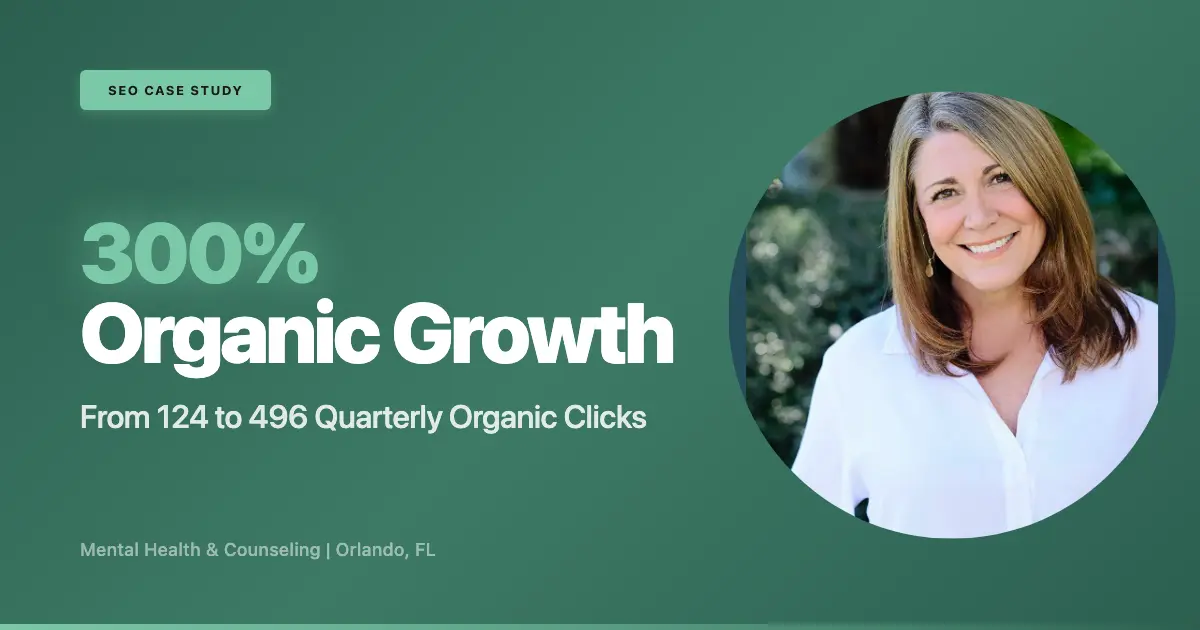
Over the tracking period, quarterly organic clicks grew from 124 to 496, a 300% increase. More importantly, the average search position improved from 52.8 to 10.1, moving the site from total obscurity to the top of page one for several targeted queries.
The quarterly trajectory shows one important nuance: Q2 dipped slightly from Q1 (119 vs 124 clicks). This is a known seasonal pattern in therapy demand: summer months typically see reduced search volume for mental health services as people's routines shift. The recovery in Q3 and the acceleration in Q4 reflect both the seasonal rebound and the compounding effect of a growing content library.
Monthly impressions grew from 6,349 to over 61,000, demonstrating that the site is now appearing in search results for a much broader set of queries. GA4 sessions grew dramatically from approximately 200 per month to over 1,000 at peak, confirming that the organic visibility is translating into real website visitors.
The content strategy produced several page-one rankings for topics like "covert narcissist abuse" and related queries, which became the single largest traffic driver on the site. Content targeting the covert narcissism topic cluster accounts for the majority of the impression growth from 6,349 to over 61,000 monthly, proof that identifying one underserved topic cluster and owning it completely can move the needle more than spreading content across a dozen average topics.
"Hiring REK has been the best decision I've ever made for my business. The entire REK team are the best at what they do...my results have been nothing less than phenomenal. Highly recommend!"
Dorian Race, Evolve Counseling & Wellness
| Metric | Starting (Q4 2024) | Current (Q1 2026) |
|---|---|---|
| Quarterly Organic Clicks | 124 | 496 |
| Monthly Impressions | ~6,300 | ~61,500 |
| Average Search Position | 52.8 | 10.1 |
| GA4 Monthly Sessions | ~200 | ~1,004 (peak) |
| Google Reviews | 5 at 5.0 Stars | 5 at 5.0 Stars |
Quarterly Growth Trajectory
Frequently Asked Questions
Does SEO work for therapy practices and mental health providers?
Yes, and it's often more effective than paid advertising for this vertical. People searching for therapy topics are usually in a high-consideration phase. They're not clicking an ad impulsively. They're researching, reading, and building trust before they reach out. A content strategy that answers the specific questions your ideal clients are searching positions your practice as the trusted resource they come back to when they're ready to book. Organic search captures that intent in a way paid ads rarely can.
How do you do SEO for a therapy practice without violating HIPAA?
The content strategy focuses entirely on educational and informational content: topics, conditions, and experiences that potential clients are searching for, without referencing any specific client information. Service pages describe what the practice offers. Blog content addresses the mental health topics clients research before seeking help. There are no client testimonials in the traditional sense. The trust is built through content quality and consistency, not through social proof that could implicate client privacy.
Why did covert narcissistic abuse content perform so well?
Because it's underserved and high-intent. A large number of people searching this topic are in relationships or recovering from relationships where they experienced this dynamic, and they're looking for validation, understanding, and next steps. Most therapy websites don't have substantive content on this topic. Creating genuinely helpful, well-researched content on a high-volume, underserved topic is one of the fastest ways to build organic visibility, and Evolve's content on this topic became the site's single largest traffic driver.
What is a realistic timeline for SEO results for a small therapy practice?
The first meaningful ranking gains typically appear between months three and five, with consistent growth from there. Evolve's quarterly trajectory went 124, 119, 193, 496. The Q2 dip was seasonal (summer months typically see reduced therapy search demand), and the Q3 and Q4 numbers reflect the compounding effect of a growing content library. For a small practice with a focused content strategy, page-one rankings for targeted topics are achievable within six to nine months.
Key Takeaway
Evolve Counseling proves that organic search is one of the most valuable marketing channels a therapy practice can invest in, specifically because of the constraints that make other channels hard. You can't run aggressive ads for a therapy practice. You can't plaster client testimonials on your homepage. What you can do is show up when someone is searching for help at 11pm on a Tuesday, find the content that explains what they've been experiencing, and give them a reason to call. That's what this strategy did. A practice that was invisible in search now consistently appears on page one for the exact queries its ideal clients are typing.